What an update actually looks like, shown with screenshots taken
in-game. The full day-by-day list lives in Recent Changes; this page picks
out the changes you can see and explains them with pictures. Every scene below is
somewhere you can fly to yourself.
The newest is 4 August 2026 — you can fly into a galaxy.
Older updates follow further down.
You can fly into a galaxy 2026-08-04
Nebulae and clusters have long let you go inside them as you approach. Galaxies did not —
from far away one was a single photograph, and the moment you crossed within three times its radius that
photograph vanished and nothing took its place. You could fly 2.5 million light-years to
Andromeda and arrive in empty space. Galaxies now have an interior. The day-by-day summary is in
Recent Changes.
The core of the Andromeda Galaxy (M31) — where 2.5 million light-years of travel puts you. The dark
disc ringed with light on the right is this galaxy's central supermassive black hole, wrapped in the
densely packed old stars of the bulge. The pink points streaming off to the left are places
where stars are being born (HII regions), and they trace a spiral arm. There used to be nothing here at all.
🔭 Measurements decide the shape. Spiral, edge-on disk, dusty elliptical or
Magellanic — along with inclination and position angle on the sky — all come from the catalogue. The
stellar velocity dispersion around the central black hole sets how much of the galaxy is bulge, and
even the diameter is derived rather than hand-typed: Andromeda spans 3.0° at 2.5 million light-years,
so about 130,000 light-years across. Only what the catalogue does not record — individual star
positions, how tightly the arms wind — is generated procedurally, and it is kept apart from what was measured.
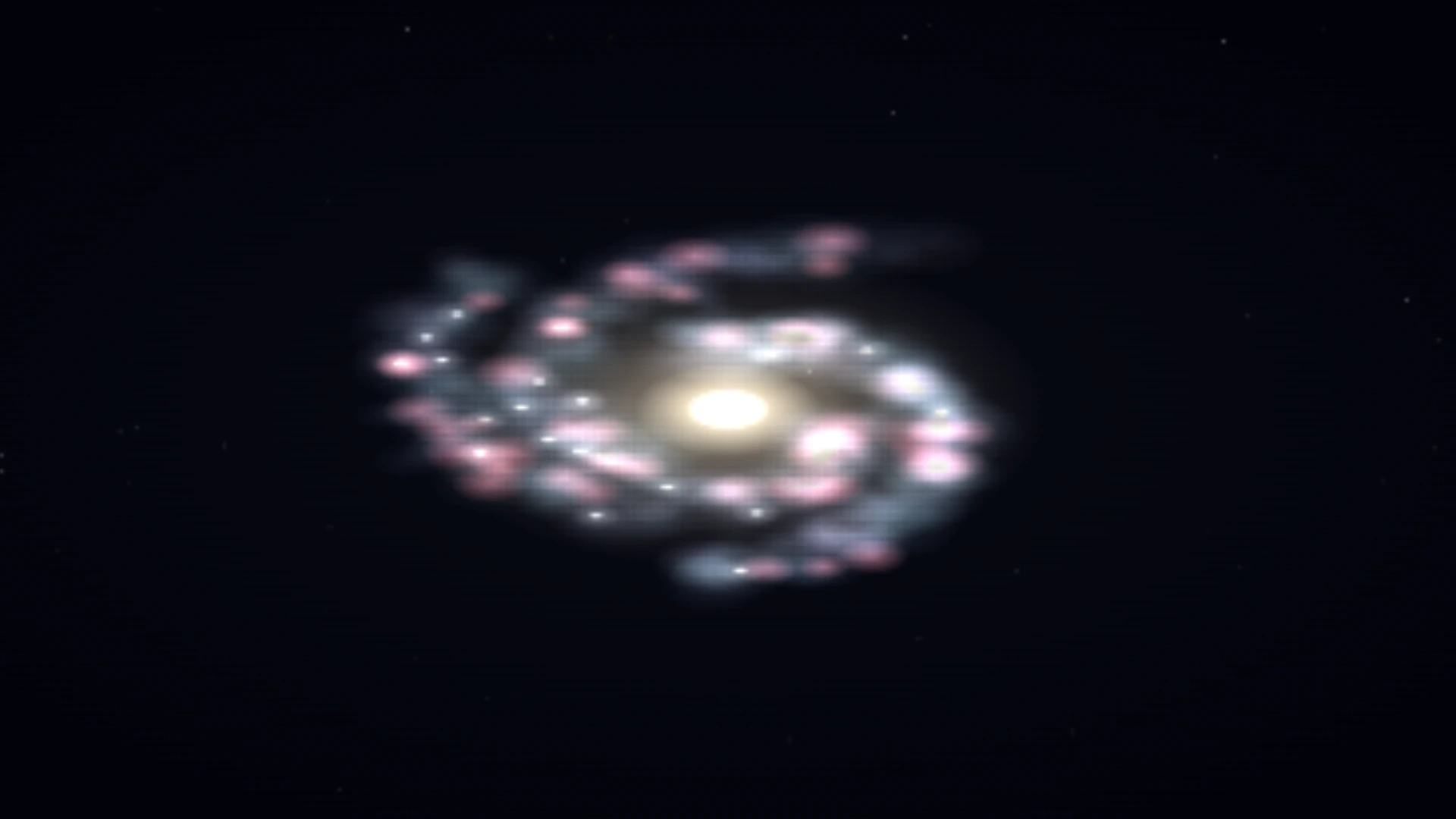
The Whirlpool Galaxy (M51) — the disk is turned almost face-on to you (20° inclination), so you
can watch the spiral wind. Pink star-forming regions stud the arms as they reach out from
the bright core, carrying on for nearly two turns to the bottom of the frame. About 280,000
light-years across. The number of arms and how tightly they wind aren't in the catalogue, so
they're generated; the inclination and the diameter are measured.
Centaurus A (NGC 5128) — one word, "galaxy", covers this too. With no spiral arms, it is a
dusty elliptical: old yellow stars massed into a ball, and out of the black hole at its centre
comes a jet. That jet is not invention — it is a measured flag in the catalogue, so it is
placed here as well. About 160,000 light-years across.
Inside the Large Magellanic Cloud — it is our neighbour, so individual stars read coarsely.
The white blaze at the centre is the Tarantula Nebula (30 Doradus) — really the most active
star-forming region in the Local Group, and a measured signature of this galaxy, so it is placed
here too. Set beside the three above, the Magellanic disorder — no arms, no defined core — is unmistakable.
How to get there. Most famous galaxies are reached by selecting their central
black hole as the destination (Andromeda, M51, the Sombrero, Centaurus A). Places where the galaxy
itself is the destination — the LMC, Triangulum, the Pinwheel — work exactly the same way.
Places worth visiting →
Exoplanets look different from each other 2026-07-31
Until now, 122 exoplanet giants were literally the same picture. The code choosing a
planet's surface colours looked up its palette by the body's name instead of its kind, and
the only names that matched were solar-system ones. Every other giant fell through to
Jupiter's palette — even the blue ice giants. The day-by-day summary is in
Recent Changes.
Wolf 359 b — a golden gas giant · radius 44,396 km. The server had always assigned this planet a
warm tan, and it had never once reached the screen. Its bands and zones are now derived from that
colour, and the number and width of the bands vary per planet too (before, every giant had the same
count of bands at the same latitudes).
Wolf 359 f — a blue ice giant · the same star system as the picture above. Before this fix
the two were the same indistinguishable brown Jupiter — and since only the atmospheric limb used the
real colour, you got the contradiction of a brown body with a blue rim. Ice giants are now blue, as
ice giants are, with fewer and softer bands.
The solar system is untouched. Jupiter, Saturn, Uranus and Neptune
look up their hand-tuned palettes first, so not one pixel of them changed — their textures
are pinned by checksum and checked automatically. Only what lies outside the solar system moved.
Rigel b — a world with a molten crust · equilibrium temperature 2,232 K. A planet's look used
to come from radius alone, so a rocky planet melting against its star and a frozen one were the same
grey-brown. The equilibrium temperature set by the distance to the host star now decides too — past
1,100 K, where silicates actually melt, lava shows through the fissures like this. There are 15
rocky planets in the game above that threshold.
Luyten b — a world with oceans · equilibrium temperature 303 K, 12.2 light-years away. A real,
measured habitable-zone planet. Temperate rocky worlds with an atmosphere now get oceans, continents,
cloud bands and polar caps. The blue of the limb is not a copy of the body's colour but a separately
computed scattering colour, and the red band on the left edge is a sunset — where light takes
the long slant through the air at the day–night boundary and loses its blue.
Sirius e — an exoplanet giant with rings. Rings existed only for Saturn, Jupiter, Uranus and
Neptune. Some exoplanet giants now wear them — and since rings always lie in the equatorial plane,
a tilted spin axis tilts the rings with it. The thin line crossing the planet is the shadow the rings
cast on it.
Tau Ceti e — no longer a 'moon' · 1.8 Earth radii, 11.9 light-years. At 1.6–2.5 Earth radii these are
sub-Neptunes wrapped in a thick hydrogen envelope, yet the game drew them as cratered moons —
and let you land on them. They now render as faintly banded worlds sunk in haze, and since they have
no solid surface you plunge into the clouds instead of landing (same as a gas giant — fly it by hand
and you can climb back out). Seven worlds are in this class, including Tau Ceti e and f and
Gliese 581 c and d.
Atmospheres are decided by physics too. Whether a planet had an
atmosphere used to be essentially a coin flip, which left one exoplanet in three
airless for no reason at all. Two things are now worked out together — whether gravity can hold an
atmosphere, and whether the stellar wind has stripped it away. The second is exactly
why the Moon and Mercury are airless. The threshold is calibrated against the solar system: Earth, Venus, Mars,
Titan and Pluto come out with atmospheres; the Moon, Mercury, Europa and Callisto come out
airless.
The sky became three-dimensional 2026-07-25
Until now the stars were a picture painted on a sphere. Whichever system you flew to,
the constellations looked exactly as they do from Earth. Every star now carries its
measured distance, so the sky is re-projected from wherever your ship is —
leave the Sun and the constellations really do deform. The day-by-day summary is in
Recent Changes.
The sky from Alpha Centauri — 4.37 light-years from Earth. The bright star at right is this
system's second sun (α Cen B). Barely four light-years out and the sky is already not Earth's:
Sirius has moved 27 degrees, and at 9.5 light-years instead of 8.6 it has dimmed to 0.81×.
That comes from re-projecting each star from its real parallax distance — not an invented number,
but exactly (8.6/9.5)².
Also. Star colours got finer. Spectral types used to collapse into
seven buckets, so B0 and B9 looked identical; now the decimal subclass is used too, giving
75 distinct tints. And 190 stars genuinely vary in brightness — only those with a
measured period and amplitude were included. Algol drops 3.2× every 2.87 days as
its partner eclipses it; Betelgeuse swells and fades over 2,335 days. Wind time forward and
you can watch them.
Gaia BH3 — the black hole that doesn't shine — 32.7 solar masses, the heaviest
stellar-mass black hole in our galaxy and the nearest of its class (1,924 light-years). The point of
this photo is the missing accretion disk: its companion orbits 10.5 AU away and feeds it nothing,
so the hole glows at no wavelength at all — not even X-rays. You know it is there only because the
starlight behind it is bent into arcs. That is how it was actually found in 2024: an old,
metal-poor giant beside it was seen wobbling on an 11.6-year cycle. In game, that giant is
circling on the same orbit.
Four pieces of real research land in the game 2026-07-21
Everything in this update translates real observations and announcements from 2024–2026
into the game — and all four are places you can fly to right now. The day-by-day summary is in
Recent Changes; how research makes it into SPACE is covered in
Research in the Game.
Alpha Centauri Ab (candidate) — a candidate gas giant JWST imaged in 2024 in the
habitable zone of α Cen A, the nearest sun-like star. It carries its measured orbit
(2.1 AU, eccentricity 0.4), and the fact that follow-ups haven't re-detected it yet — its
'candidate' status — is stated right in the destination notes. A 4.37-light-year cruise:
the game's most popular star system just gained a new port of call.
128 irregular moons of Saturn — the batch the IAU confirmed in March 2025, carried with
their real measured orbits, bringing Saturn to 274 moons. Pictured: alongside S/2023 S 1,
with other members of the swarm labelled in the sky. Most orbit backwards (retrograde) in the
Norse group — debris clouds from ancient collisions. Every one is a destination you can
land on — including a 1 km rock, the smallest body in the game.
Sagittarius A* never rests — JWST's 48-hour stare at our galaxy's central black hole
revealed non-stop variability, and the accretion disk now carries it: seconds-to-minutes
flickers stacked with a few big flares a day. It runs deterministically on real wall-clock
time, so every visitor sees the same flare at the same moment — linger a while and wait
for an eruption.
A new deep-sky destination: Apep — four nested amber dust shells sculpted over
~700 years by the colliding winds of two Wolf-Rayet stars. This year JWST resolved the
ground-based 'pinwheel' into these layered shells — one of the rarest objects in the galaxy.
Find it in the sky, aim, and cruise there yourself (~7,800 light-years).
Previous update 2026-07-18
Nebulae now look like real astrophotography 2026-07-18
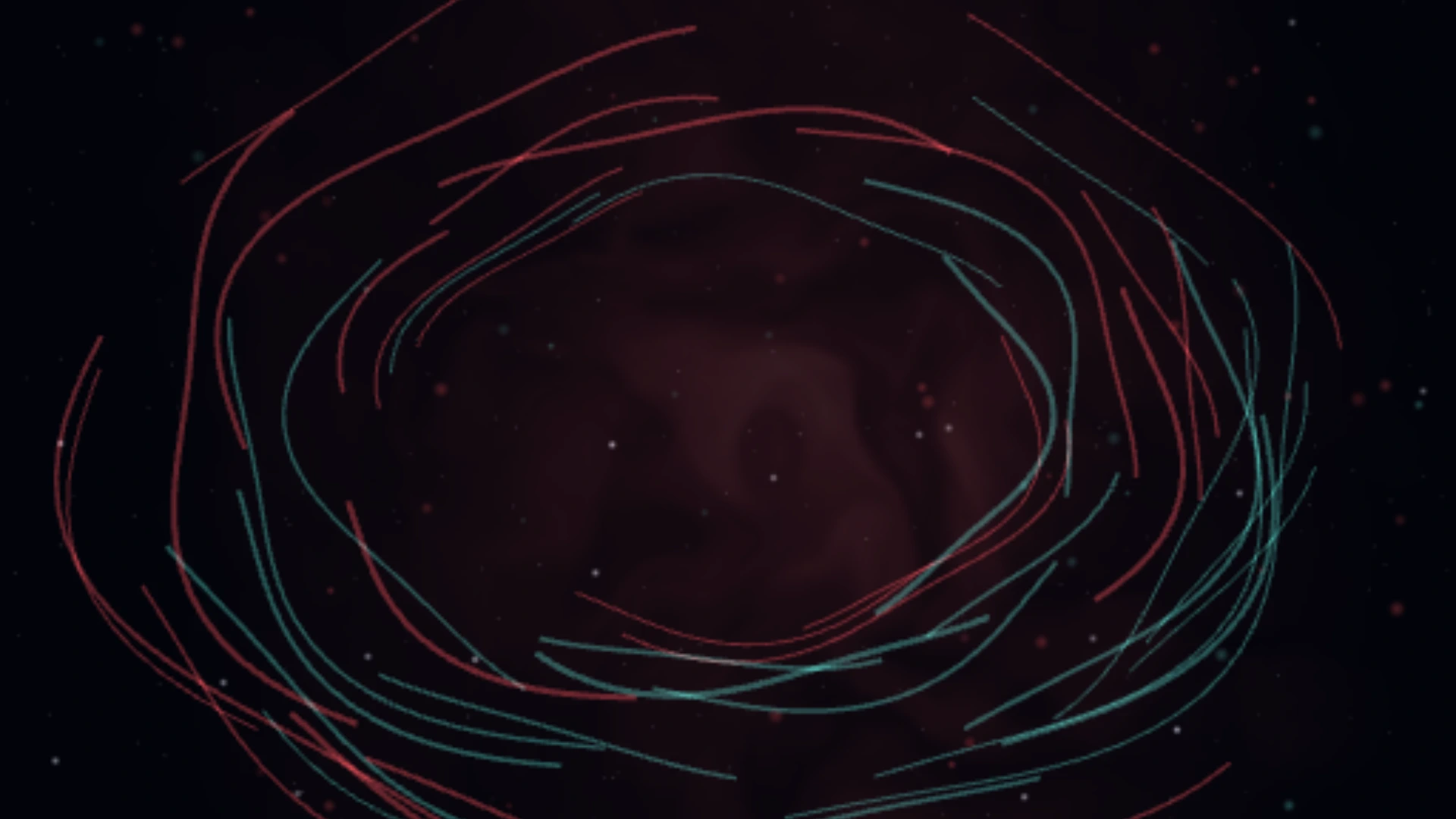
Until now a nebula was a soft gradient with thin coloured lines scribbled across it —
squiggly filaments that no real photograph has. This update rewrites how nebulae are drawn. A nebula is
now a fractal cloud of turbulent gas: red H-α through the bulk, teal O-III in the bright
ionized core, and dark dust lanes weaving between — the very layers you see in Hubble and
JWST images.
The Carina Nebula (Cosmic Cliffs) — the nebula as painted on the far sky. Golden dust clouds swirl
in turbulence with dark dust pillars rising through them. Instead of a gradient plus lines, the
brightness now varies at every scale — far closer to the nebulae in a photo book.
🔭 Inside and outside are different pictures. The far painting and the
volumetric gas you fly through inside are separate code, but both were redrawn with the same
colour science (ionization layers, dust lanes) so the inside and outside no longer disagree.
Inside the Orion Nebula (M42) — fly into the nebula's chart and red H-α gas wraps all around
you. Instead of round fog, fibrous gas tufts layer up, with newborn stars carrying diffraction
spikes embedded among them. A nebula really is where stars are born, and you thread between them.
Five more places worth visiting 2026-07-18
With the new nebula graphics changing the sky, the Places Worth
Visiting gallery gained five more beautiful deep-sky sights — the
Veil Nebula (a supernova remnant), the North America and
Cat's Eye nebulae, and Bode's Galaxy (M81) and the
Pinwheel Galaxy (M101). All were captured live in-game, each with a link that takes
you right there.
Veil Nebula (Cygnus Loop) — the supernova remnant of a star that exploded ~10,000 years
ago. Thin filaments of red hydrogen and teal oxygen curl like smoke, a very different texture of
debris from the Crab Nebula.
Bode's Galaxy (M81) — a grand-design spiral 12 million light-years away. Blue arms wrap a
golden core, with pink star-forming regions strung along them. It joins the gallery alongside the
Pinwheel Galaxy (M101).
Earlier update 2026-07-16
Arrive at a star cluster and you stand among its stars
The Pleiades (M45) has long been a place you could sail to. But arriving left the cluster still
pasted far away on the backdrop — a painting that never grew as you approached. Now, getting there
surrounds you with its stars.
Inside the Pleiades — the brilliant stars throwing diffraction spikes are the
Seven Sisters: Alcyone, Atlas, Electra, Maia, Merope… Their placement isn't invented — it comes
from their real measured sky coordinates. The familiar pattern you know from looking up from
Earth is, from inside the cluster, unfolded all around you. The hundreds of fainter stars are its
unnamed members (M45 has roughly 1,000; only nine are naked-eye), and the blue haze at upper
right is the reflection nebulosity — dust the cluster is drifting through, scattering its starlight.
🔭 Why is it blue? The nebula doesn't shine on its own — the cluster's hot
blue-white starlight scatters off the dust. For the same reason the sky is blue, scattered light
comes out bluer than the starlight itself. At about 100 million years old, the Pleiades is young enough to
still be passing through this dust.
The Virgo Cluster — same word, "cluster", but here every member is a galaxy. Arrive at
this one, 53 million light-years out, and hundreds of galaxies hang around you with a giant
elliptical at the core. The galaxies near the centre are red (old, no longer making new stars) while
blue spirals survive further out — the morphology–density relation seen in real clusters.
Saturn's rings cast their shadow onto Saturn
One of the first things you notice in a photograph of Saturn is the dark banding the
rings draw across the planet. That shadow now exists.
Saturn's ring shadow — the rings block sunlight and lay several dark bands across the
cloud tops. Look closely and there's a bright gap between them: sunlight through the empty lane
in the rings themselves (the Cassini Division). Where the rings are dense the shadow is dark;
the thin C ring casts only a faint one.
Uranus — a planet that spins almost on its side, at 97.8°. Its rings stand at that tilt,
and the shadow follows. Each planet's shadow comes from that body's real measured obliquity.
The Crab Nebula gets its supernova-remnant colours back
The Crab Nebula (M1) is the wreckage of a star that exploded in 1054. Yet it had been
painted in the pink of a nebula where stars are born — the opposite kind of place, in the same
colours.
Inside the Crab (M1) — flying through the wreckage, orange knots and blue-white
light spread around you like a thin haze. The orange is blasted material glowing as it cools; the
blue-white comes from the pulsar left at the centre, flinging out particles. This used to be the
pink of a stellar nursery.
🔍 Inside and outside differ.Inside, the nebula is this sparse haze — the
dense filament web you know from photographs is what you see from light-years away, taking in the
whole remnant at once, and in-game that's the Crab hanging in the distant sky. This fix corrected the
colours of both the distant view and the gas inside it (they're separate code — fix one and the two
disagree).
The stars' colours got the same treatment. Every star of a given class (M, B…) used to
share one colour; now they're painted from their measured spectral type. Even among red
dwarfs, Proxima and its cooler neighbours now differ subtly.