Research in the Game
The universe of SPACE is rooted in real observation. Beyond the positions, masses, and orbits of celestial bodies, we continuously fold newly published astronomy research into the game. The goal: a planet astronomers have just discovered through a telescope becomes, weeks later, somewhere you can fly to and see with your own eyes.
We take it seriously, but not too seriously. We love folding in well-established consensus results, yet a less-settled discovery is fair game too if it's interesting enough — SPACE aims for a serious universe, not a fully rigorous academic simulation. Wherever an approximation or uncertainty is involved, it is noted honestly in code comments and in our research ledger. And all of this data is gathered ahead of time and baked into the game, so the live server never makes an extra outbound request.
Fast Radio Bursts (FRBs) — cosmic radio flashes caught mid-cruise
The research
A Fast Radio Burst (FRB) is an intense radio pulse lasting a few milliseconds, most arriving from other galaxies hundreds of millions to billions of light-years away. Their origin isn't fully settled, but strongly magnetized neutron stars (magnetars) are the leading suspect. Canada's CHIME radio telescope published the CHIME/FRB Catalog 2 (arXiv:2606.26334), by far the largest FRB sample to date.
The game includes well-characterized real FRBs — the 16.35-day periodic repeater FRB 20180916B, the first-ever repeater FRB 20121102A, the nearest one FRB 20200120E (in a globular cluster of the M81 galaxy), the first Milky-Way FRB from the magnetar SGR 1935+2154, and the most distant and energetic FRB 20220610A. Each burst's sky direction (RA/Dec) and dispersion measure (DM) are the real observed values.
How it's in the game
- During an interstellar cruise, a light-delayed radio burst occasionally arrives from a real FRB's sky direction — the screen flashes toward it and a notification names the FRB and its dispersion measure. Travelling at light speed, the burst is an event that happened long ago and far away.
- Which window brings which FRB is fixed deterministically per cruise (reproducible, not random). Longer voyages sweep more sky, more often.
- This is the game's first one-off transient event mechanism — future encounters, like interstellar visitors ('Oumuamua/Borisov/3I ATLAS) flying past, will grow on top of it.
Little Red Dots — JWST's crimson mystery
The research
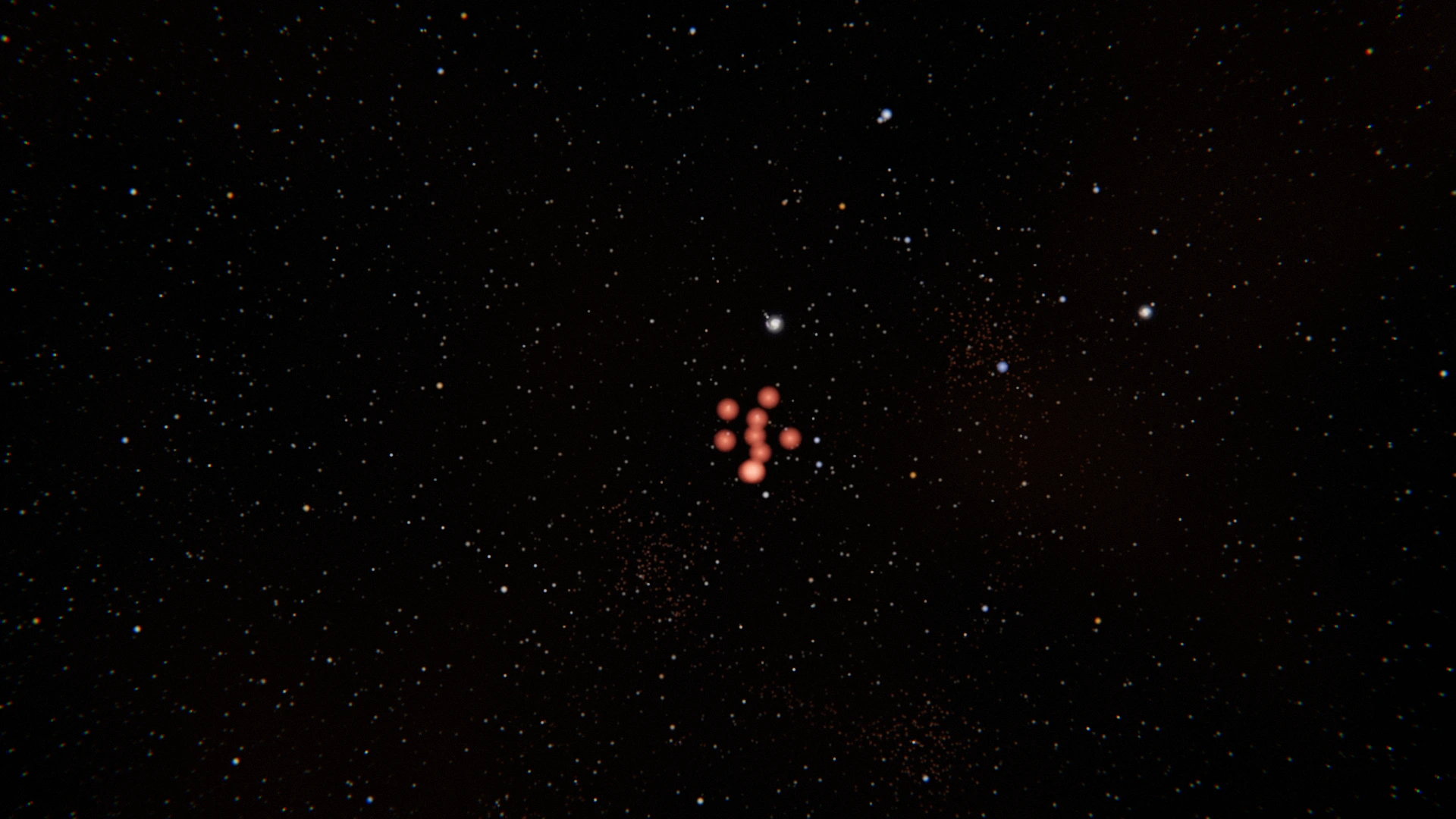
Peering into the early universe, the James Webb Space Telescope (JWST) found something unexpected — tiny, strikingly red point sources clustered together. These "Little Red Dots" appear to be compact active galactic nuclei (AGN) at redshift z ≈ 4–9 (when the universe was 1–1.5 billion years old), glowing red with dust reddening. The biggest puzzle is that their number density stays nearly constant across cosmic time (arXiv:2606.30253, the EIGER J1030 field plus the CEERS/JADES/UNCOVER deep fields).
How it's in the game
- We seeded clusters of red point sources toward the sky directions of 7 real JWST deep fields (GOODS-S · CEERS · UNCOVER · COSMOS · EIGER J1030 · GOODS-N · UDS). Look toward the deep-sky backdrop in those directions and you'll see clumps of deep-red points characteristic of high redshift.
- Each dot's redshift is distributed deterministically across z ≈ 4–11, and its color follows naturally from redshift physics — the farther, the redder. A catalogue/visual-only addition, so the simulation's determinism is unchanged.
Nearby exoplanets, ingested in bulk — 9 measured systems → 21
The research
The solar neighbourhood within ~20 light-years is the best-surveyed patch of the galaxy for precision radial-velocity work. CARMENES confirmed Teegarden's Star b & c (Zechmeister et al. 2019; d added in 2024), Ross 128 b is a temperate Earth-sized world (Bonfils et al. 2018), the RedDots campaign delivered GJ 887 (Lacaille 9352) b & c (Jeffers et al. 2020), Luyten's Star b (Astudillo-Defru et al. 2017) and Gliese 667 C c (Anglada-Escudé et al. 2013) are habitable-zone super-Earths, and JWST directly imaged the cool jovian Epsilon Indi Ab (Matthews et al. 2024).
This batch brings the measured planets of 12 systems — also including Wolf 1061, Gliese 1061, YZ Ceti, Lalande 21185, Gliese 832 and Pollux — in at their NASA Exoplanet Archive values (semi-major axis, eccentricity, mass), for a total of 21 systems with real planets. Refuted or disputed candidates (GJ 832 c, GJ 667C d–g, …) were left out.
How it entered the game
- Cruise to any of these systems and the measured planets are there, on their measured orbits — habitable-zone worlds (Teegarden b/c, Ross 128 b, Wolf 1061 c, Gliese 1061 c/d, …) carry atmospheres, and landings fly the re-entry corridor.
- Radial velocity gives only minimum masses, so radii are estimated with the rocky mass–radius relation (R≈M0.27, Zeng et al. 2016) — the same convention as the Barnard's Star entry.
- Alpha Centauri's companion B also joined, on its measured binary orbit (a 23.5 AU · e 0.52 · P 79.9 yr) — arrive and two suns rise. The companion is a real gravity source, not decoration.
LTT 9779 b — an exoplanet that shines like a mirror
About the paper
LTT 9779 b is the only known "ultra-hot Neptune" observed to
date. Most planets cannot survive packed this close to their star, boiling away their atmospheres
in this size-and-temperature zone — the so-called Neptune desert — yet LTT 9779 b is its
one lone survivor. In 2026, JWST detected silicate (Mg₂SiO₄) clouds in the planet's
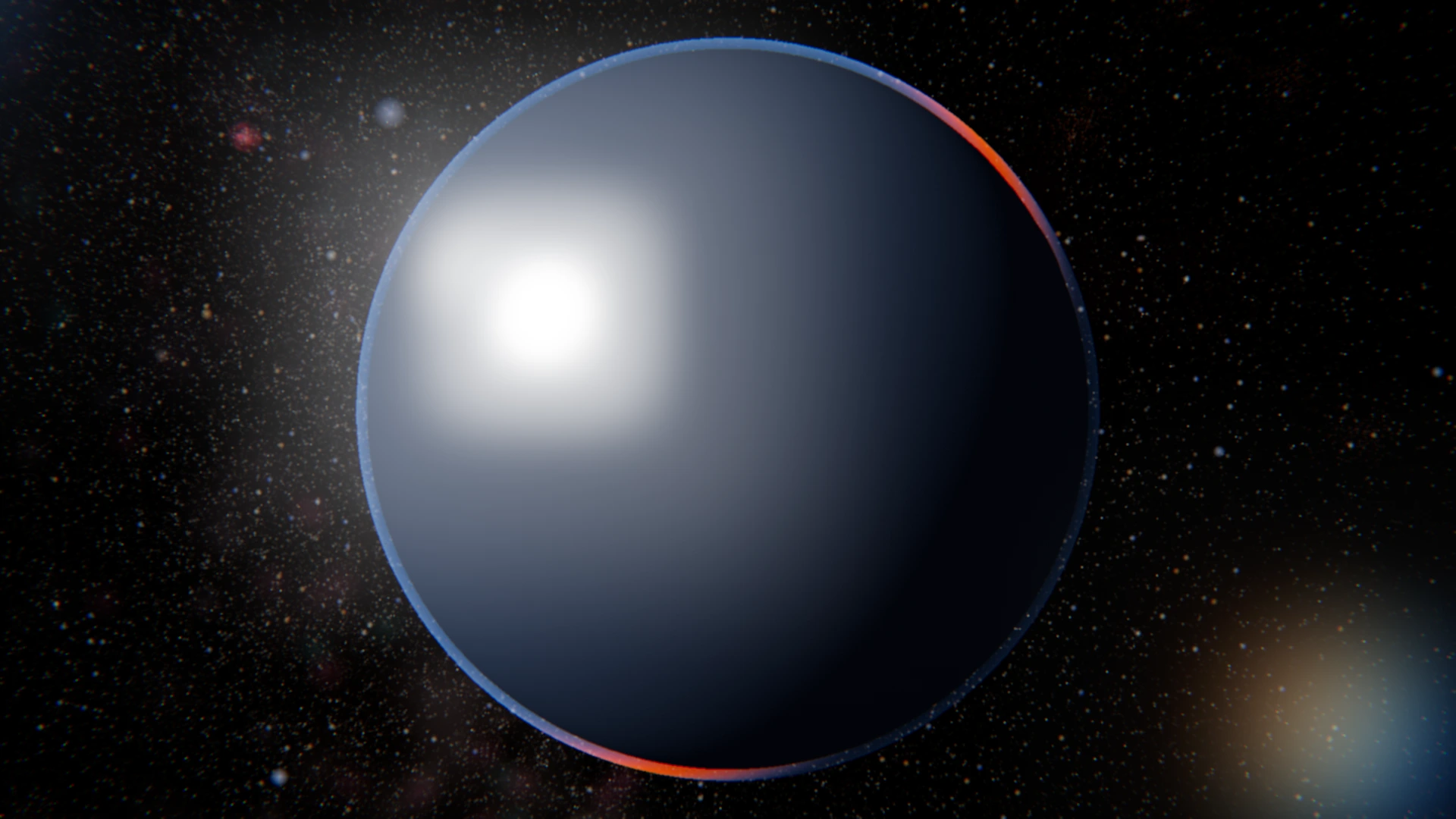
dayside atmosphere (arXiv:2606.26075). Those metallic clouds bounce starlight back like a mirror,
giving it a geometric albedo of about 0.80 — among the most reflective planets
known. Quite literally a "mirror planet."
Discovered by Jenkins et al. (2020), its extreme reflectivity pinned down by CHEOPS (Hoyer et al., 2023), and its atmosphere cross-checked by ESPRESSO and JWST spectroscopy — a famous planet confirmed across many years and instruments.
| Parameter | Value |
|---|---|
| Mass | 29.3 M⊕ (~29× Earth) |
| Radius | 4.7 R⊕ |
| Orbital period | 0.79 days (a full orbit in under a day) |
| Semi-major axis | ~0.0168 AU (almost grazing its star) |
| Geometric albedo | ~0.80 (mirror-grade reflection) |
| Host star | LTT 9779 (G-type, 264 ly) |
How we put it in the game
- We added the host star to the star catalog — LTT 9779 is now a real destination reachable by interstellar cruise (264 ly, coordinates from SIMBAD).
- We registered planet b in the exoplanet catalog. From the mass and period known via radial velocity (RV), Kepler's third law recovers the orbit, and the planet is synthesized in place on arrival.
- The "mirror surface" look: the albedo-0.80 flag is propagated from the server all the way to the client, which renders it as a metallic (metalness 0.92, roughness 0.12), low-saturation white self-lit material. So right beside the host star you see a dayside whose surface gleams like a mirror.
- Because this is a catalog-and-visual addition only, the simulation's determinism is untouched — the planet is realized only when you actually arrive there.
Barnard's Star — a four-planet system around the nearest single star
About the paper
Barnard's Star is the second-closest star to the Sun (after the Alpha Centauri triple system) and the nearest single star — one that stands alone (~6 ly, an M-type red dwarf). It was a planet-hunters' target for over a century with nothing to show for it, and even a 2018 cold super-Earth candidate (Ribas et al.) was disproven in 2021, making it a poster child for "a star with no planets."
That silence was broken by precise radial-velocity (RV) campaigns in 2024–2025. ESPRESSO confirmed planet b in 2024 (González Hernández et al., 2024), and a joint ESPRESSO and MAROON-X analysis in 2025 extended it to four planets (b, c, d, e) (Basant et al., 2025). All are sub-Earth rocky planets, packed so close to the red dwarf that they orbit in a matter of days — hot orbits inside the habitable zone, because the star itself is small and dim.
| Planet | Semi-major axis | Radius (estimated) |
|---|---|---|
| d | 0.0188 AU | ~0.70 R⊕ |
| b | 0.0229 AU | ~0.72 R⊕ |
| c | 0.0274 AU | ~0.74 R⊕ |
| e | 0.0381 AU | ~0.64 R⊕ |
Host star: Barnard's Star (M4 red dwarf, ~6 ly). Orbital periods are a few days each (d ≈ 2.3 days to e ≈ 6.7 days).
How we put it in the game
- We registered all four planets in the exoplanet catalog. Cruise to Barnard's Star and a four-planet system grounded in real measurements unfolds in place.
- RV gives only the minimum mass, so radii are estimated from a rocky mass–radius relation (R≈M0.27, Zeng et al. 2016) and semi-major axes are recovered via Kepler's third law — all noted in code comments and the research ledger.
- We retired the long-disproven Ribas 2018 candidate and replaced it with the latest confirmed planets, keeping the game scientifically current.
- Being a catalog-only addition, it is realized only on arrival and the simulation's determinism is untouched.
CD-35 2722 B — the first exomoons ever detected Exomoon
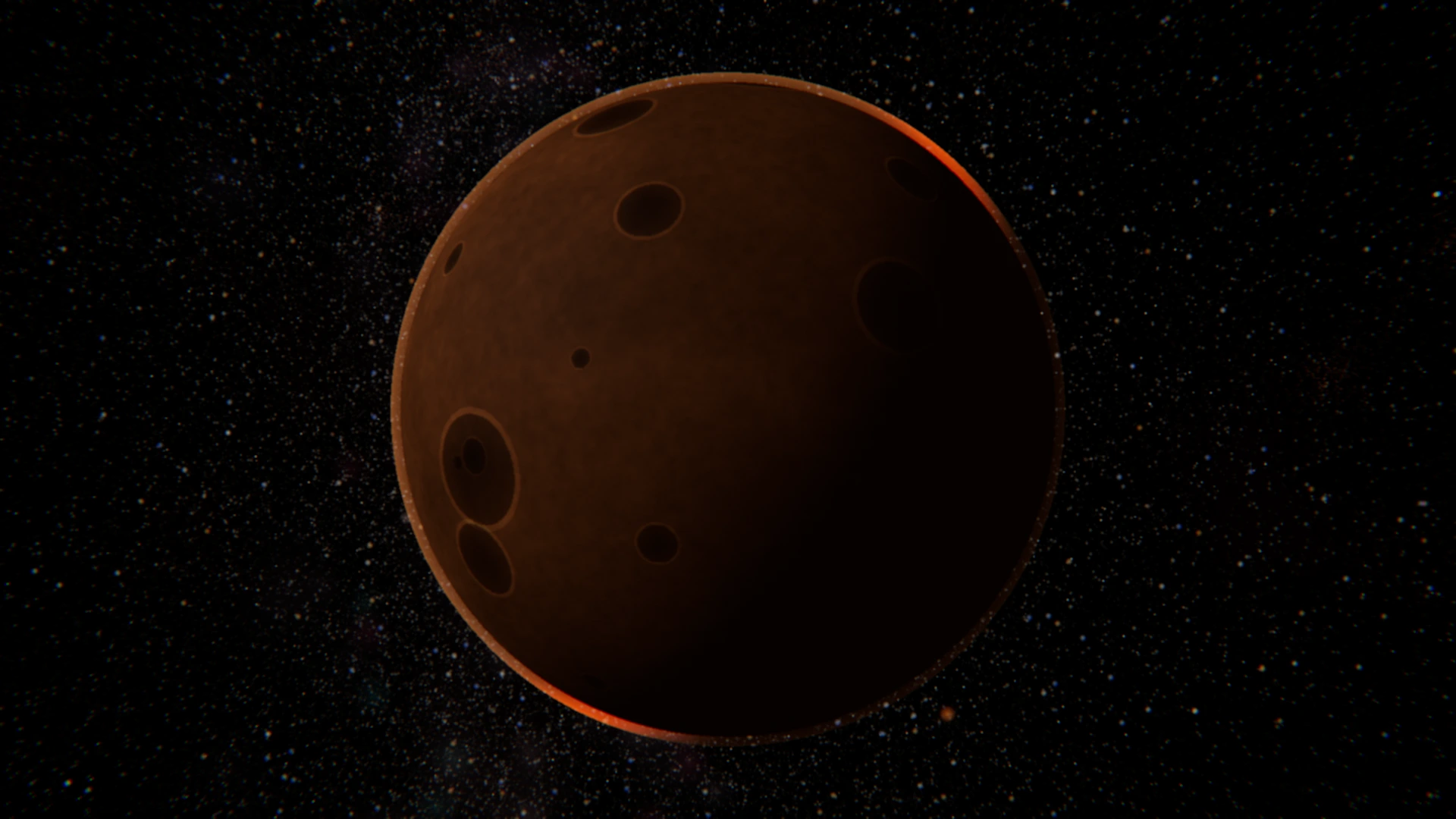
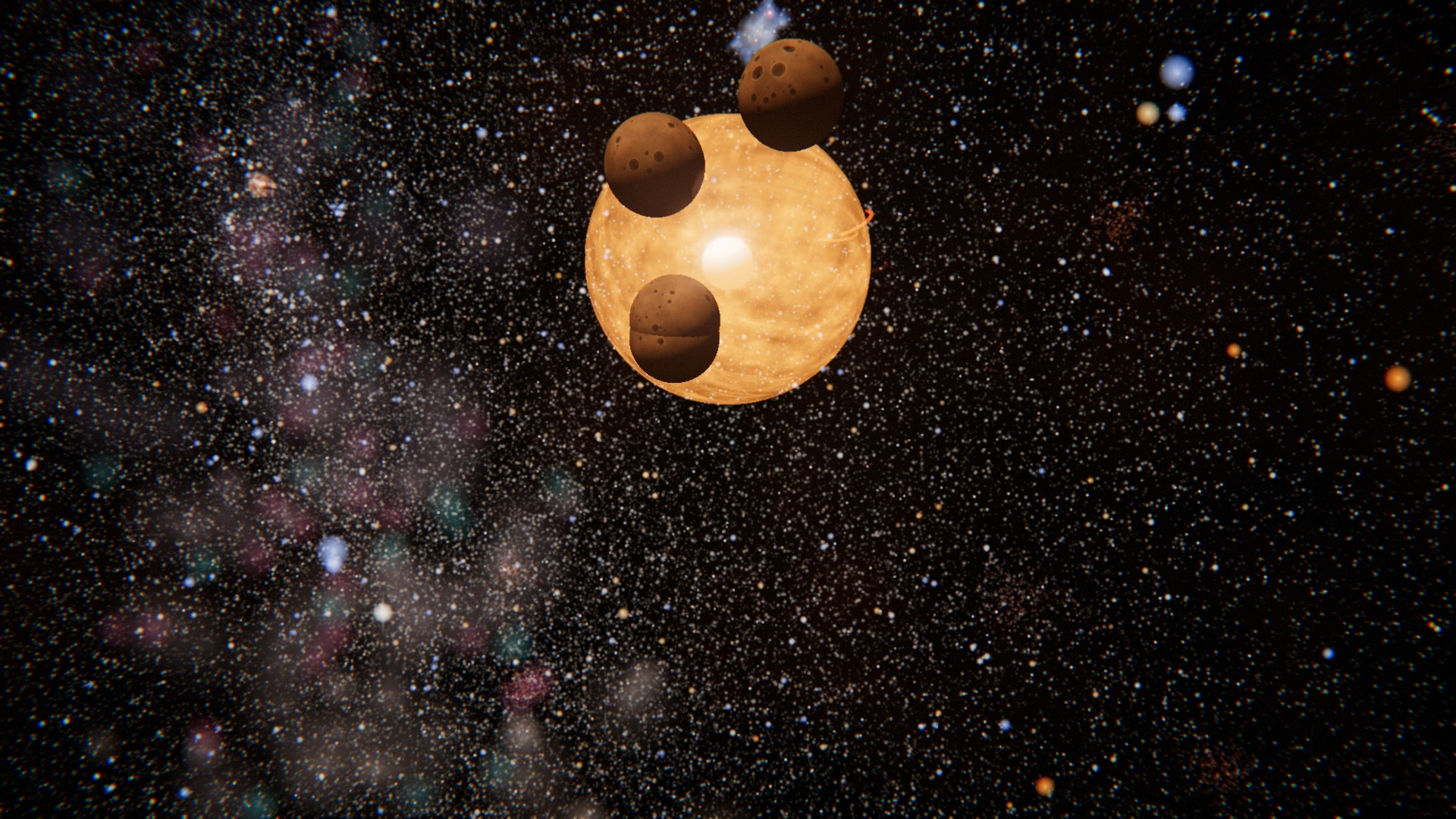
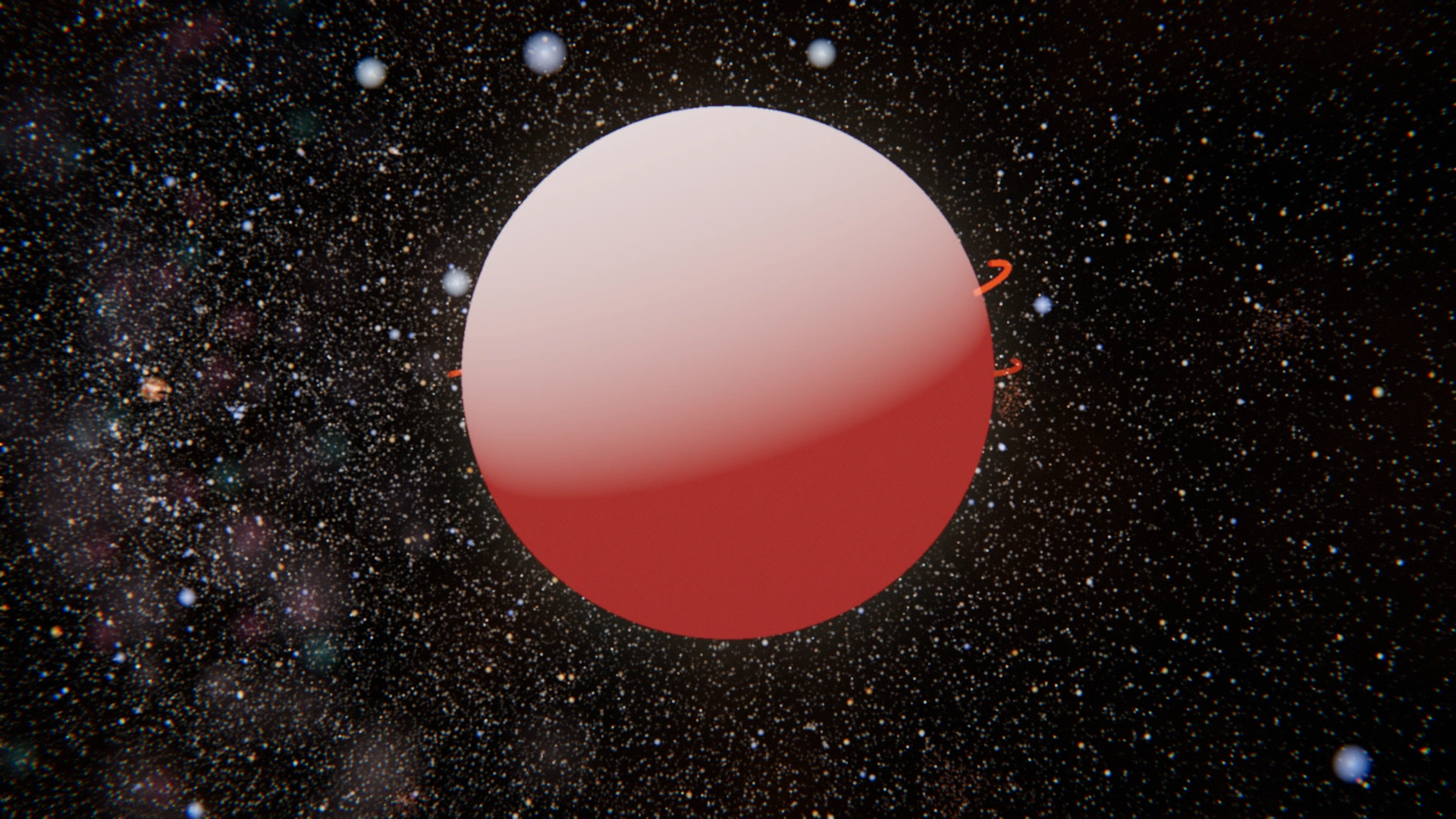
More than 6,000 exoplanets have been found, but a moon orbiting one had never been confidently detected — until, in 2026, two satellites were found around CD-35 2722 B, the first confident exomoon detection (Hoy et al., Nature 2026; arXiv:2607.05193). CD-35 2722 B is the brown-dwarf companion of a distant red dwarf (CD-35 2722, ~73 ly); wobbles in its spectrum (radial velocity) reveal two satellites of 0.74 and 0.28 Jupiter masses orbiting near a 2:1 resonance — just like Jupiter's Galilean moons. The game adds this brown dwarf to the star catalog and places its two moons on their measured periods (169 and 87 days) — cruise there and see the dim rusty-red brown dwarf with its two moons around it. (The detection is by radial velocity, so only minimum masses are known — the radii are honestly estimated as gas giants.)
3I/ATLAS — the third interstellar object Interstellar
3I/ATLAS (C/2025 N1), discovered in July 2025, is the third interstellar object ever observed, after ‘Oumuamua and Borisov (Seligman et al. 2025, MNRAS Letters 542 L139) — a visitor on a steeply hyperbolic orbit (eccentricity e≈6.1) that is not bound to the Sun. The game carries the comet at its measured orbital elements (perihelion q≈1.36 AU, passing 2025-10-29) and lists it among the interstellar intruders — fly close and it renders with a red coma and dust tail, unlike the teal of solar-system comets, and mid-cruise you can even get a close flyby encounter with one of these visitors.
TOI-6884 b — a brown dwarf that never became a star Brown dwarf
TOI-6884 b is a 26-Jupiter-mass brown dwarf circling an F-type star every 4.8 days (arXiv:2606.29666). Heavier than a planet but too light to ignite as a star, it is a degenerate "failed star" — Jupiter-sized yet 26 times its mass. The game adds the host star TOI-6884 (F7, 690 ly) to the star catalog and places the brown dwarf beside it at its measured orbit (a 0.063 AU, e 0.067) — cruise there to see the dense, dark-red body up close.
Sagittarius A* — the supermassive black hole at our galaxy's center Black hole
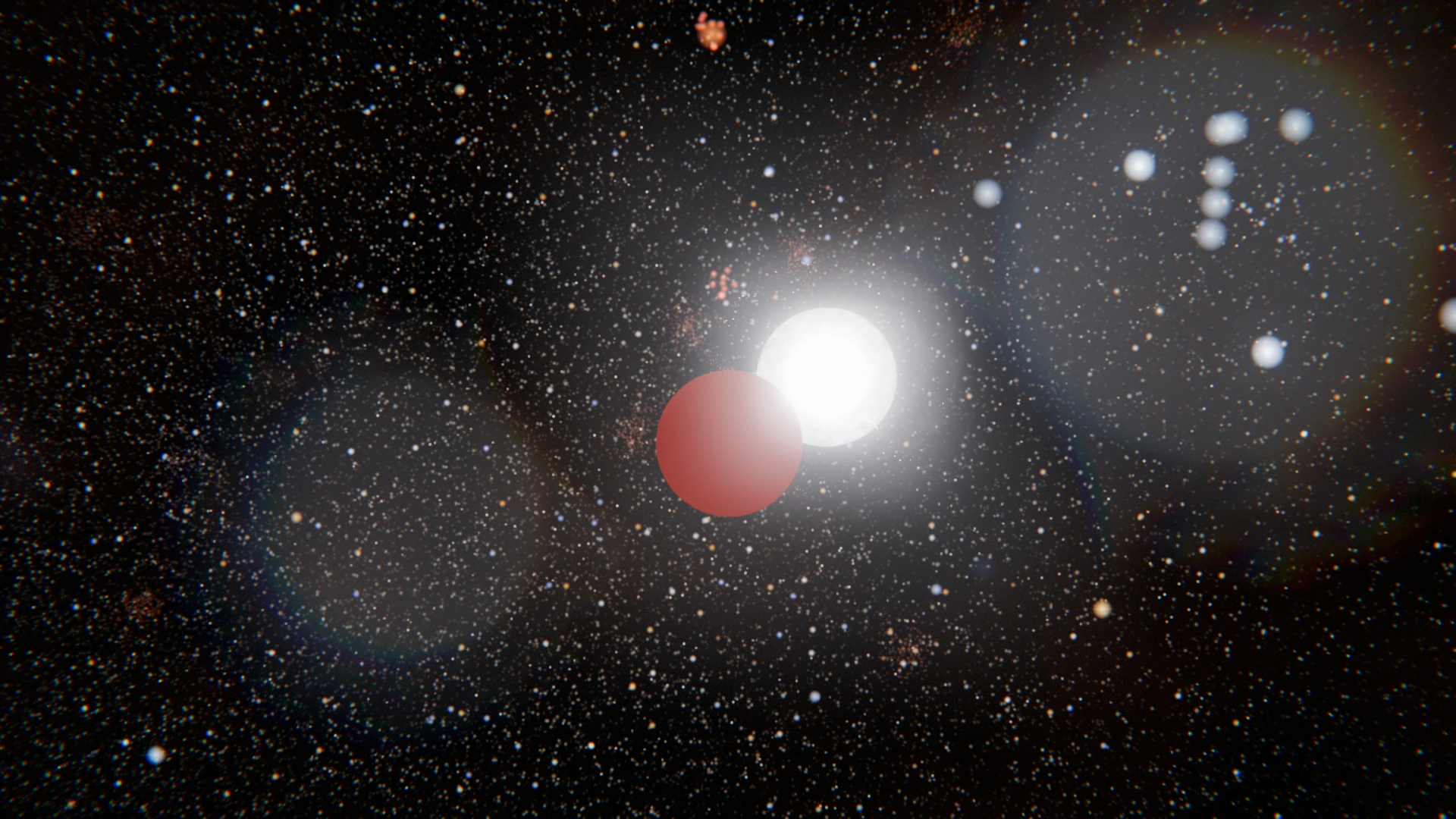
The GRAVITY Collaboration (2022) precisely tracked the orbits of stars circling the galactic center, remeasuring the central black hole's mass and distance — about 4.3 million solar masses, ~26,996 light-years away. The game updates Sagittarius A*'s mass and distance to these values. Beside it you can see the event-horizon shadow, the warped photon ring, and the swirling accretion disk (→ the physics of black holes).

Planck 2018 — standard cosmological parameters Cosmology
The Planck satellite's final analysis of the cosmic microwave background (CMB, 2018) nailed down the universe's fundamental constants. The game adopts the standard ΛCDM cosmology with these values — Hubble constant H₀ 67.4, matter density Ωm 0.315, dark energy ΩΛ 0.685, a 13.8 billion-year-old universe. The cosmology clock you toggle with U, and the redshift, lookback-time, and accelerating-expansion calculations, all flow from these numbers (→ the physics of cosmic expansion).